


For many international dentists preparing to apply to Advanced Standing dental programs in the United States, the terms shadowing and observership come up frequently.
Both can provide valuable exposure to dentistry in the United States, but they are not the same as working as a dentist—and understanding that distinction is important.
So what exactly is an observership? How is it different from shadowing? And if you are not allowed to treat patients, why can the experience still be useful?
What Is Dental Shadowing?
Shadowing is generally the simplest form of clinical observation.
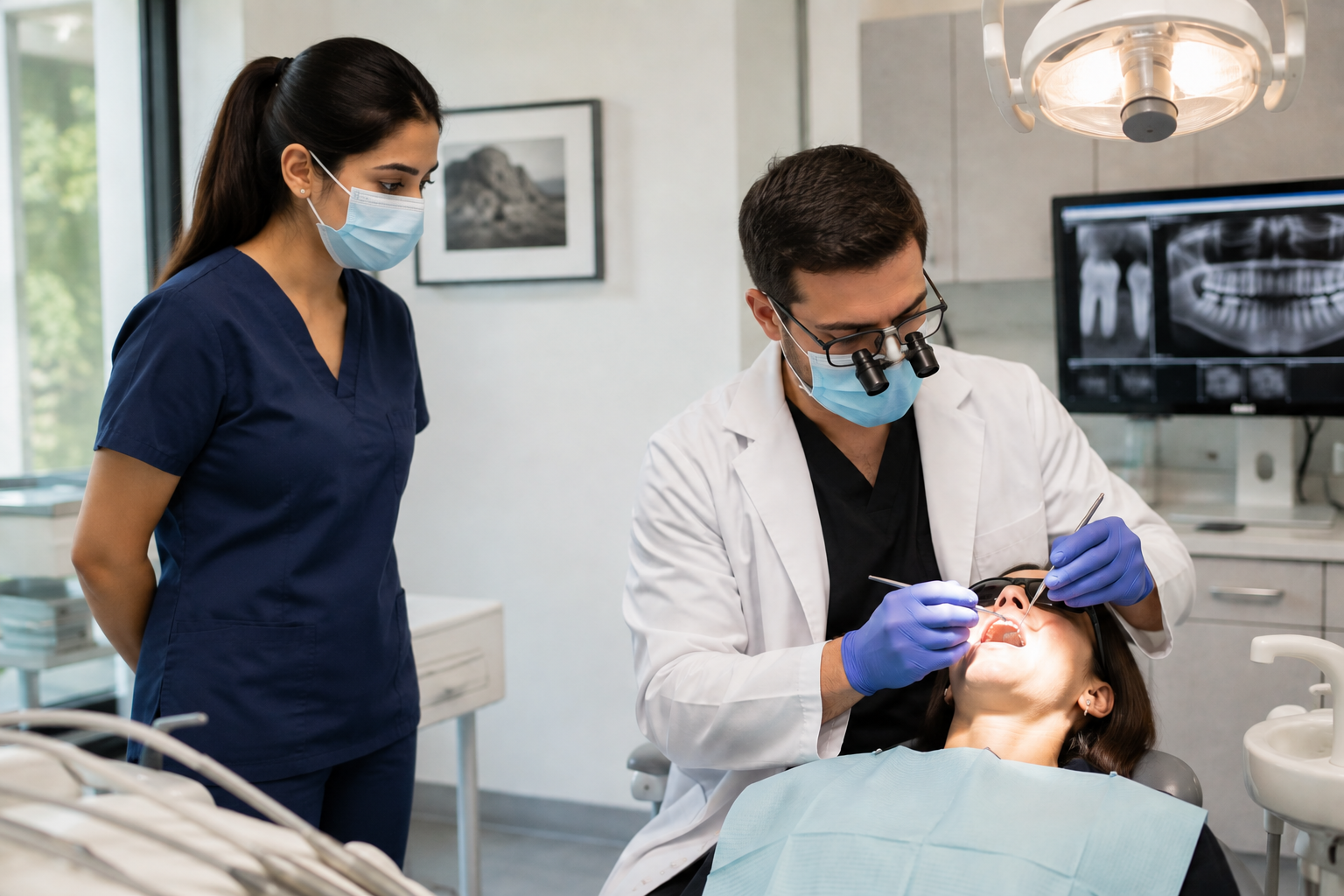
A dentist allows you to spend time in the practice and observe what happens during a normal working day. You may watch patient consultations, restorative procedures, treatment discussions, sterilization protocols, communication between team members, and the general flow of the office.
The purpose is observation.
You are there to understand how dentistry is practiced, not to provide treatment.
For international dentists, even a short shadowing experience can be helpful because the daily workflow of a U.S. dental practice may be very different from what they experienced in another country.
What Is a Dental Observership?
An observership is also primarily observational, but it can be more structured.
Instead of simply following a dentist from room to room, an observership may expose the participant to different parts of the practice, such as:
- Digital radiography and imaging
- CBCT technology
- Intraoral scanning
- Treatment planning
- Practice-management software
- Patient communication
- Infection-control protocols
- Clear-aligner workflows
- Digital dentistry
- Coordination between the dentist, assistants, hygienists, laboratory, and front office
The exact experience depends on the dental practice and the rules governing what an observer is permitted to do.
An observership should not be confused with employment, residency, dental school training, or a clinical externship.
An observer is generally there to watch, learn, ask appropriate questions, and understand the environment.
If You Cannot Work on Patients, Why Is It Helpful?
This is one of the most common questions international dentists have.
The value of an observership is not simply learning how to perform a procedure.
Most experienced international dentists already understand dentistry.
The value is learning how dentistry functions in the United States.
You begin noticing things that cannot always be learned from textbooks or online videos.
How does the dentist explain a crown to a patient?
How is informed consent discussed?
How does the team manage a busy schedule?
How are radiographs organized?
How is treatment presented?
How are insurance considerations incorporated into the workflow?
How does a digital scan move from the operatory into treatment planning?
How does the dentist communicate with assistants, laboratories, specialists, and patients?
These details help create a much broader understanding of practicing dentistry in the United States.
For someone applying to an Advanced Standing program, this exposure can also make conversations about U.S. dentistry more meaningful because they are based on experiences you have actually observed.
Observing Is Different From Practicing
International dentists should understand this clearly.
An observership does not give someone permission to practice dentistry in the United States.
You should not expect to prepare teeth, administer anesthesia, diagnose patients independently, perform irreversible procedures, or function as the treating dentist simply because you are participating in an observership.
The exact boundaries depend on the practice, institution, state regulations, patient privacy requirements, and the nature of the program.
A professionally organized observership respects those boundaries.
The goal is exposure—not unauthorized clinical practice.
And that exposure can still be extremely valuable.
Why Can Dental Observerships Be Difficult to Find?
Finding a meaningful observership can be surprisingly challenging.
A working dental practice has responsibilities that come before teaching observers.
Dentists are treating patients. Team members are managing schedules. Patient privacy must be protected. Operatories may already be busy, and having additional people in the practice can interrupt normal workflow.
There are also liability, confidentiality, infection-control, and administrative considerations.
For these reasons, many dentists simply cannot accommodate observers—even when they would otherwise like to help.
Another challenge is that international dentists often contact practices they have no previous relationship with.
From the dentist’s perspective, allowing someone they have never met to spend several days or weeks inside a working practice requires a considerable level of trust.
This is why sending dozens of emails does not always produce an observership opportunity.
It isn’t necessarily because practices are unwilling to help.
Often, it is simply difficult to incorporate an observer into a busy clinical environment.
How Long Should a Dental Observership Be?
There is no single perfect duration.
Even a few days can provide useful exposure.
However, very short experiences sometimes allow you to see only isolated procedures without understanding how the practice operates as a whole.
A longer experience gives you the opportunity to observe different patients, different procedures, different technologies, and different situations.
For many international dentists, approximately one to two weeks of consistent observation can provide a meaningful introduction to the workflow of a dental practice.
Longer experiences can also be valuable when available, particularly if the observer continues learning rather than simply watching the same routine repeatedly.
The quality of the experience matters more than collecting the largest possible number of hours.
Is a Longer Observership Always Better for an Application?
Not necessarily.
Spending hundreds of hours inside a dental office does not automatically make an application stronger.
Admissions committees evaluate applicants as individuals, and every dental school has its own priorities.
A more useful question is:
What did you actually learn from the experience?
Could you explain how the experience changed your understanding of U.S. dentistry?
Did you observe differences in patient communication?
Did you learn about digital workflows?
Did you better understand interdisciplinary care?
Did the experience help you recognize something you need to improve before dental school?
A meaningful experience that you can reflect upon authentically can be more valuable than simply listing a large number of observational hours.
Shadowing and Observerships Are Part of a Bigger Journey
For an international dentist, preparing for an Advanced Standing program involves much more than completing an application.
You are learning a new dental environment.
You may be preparing for bench examinations.
You may be adjusting to different materials, instruments, terminology, technology, patient expectations, and clinical workflows.
Shadowing and observership experiences can help connect those pieces.
They allow you to see how dentistry looks beyond the classroom and beyond the bench examination.
The Astra Approach
At Astra Test Prep in Pasadena, California, our primary focus is hands-on preparation for international dentists preparing for Advanced Standing bench examinations.
But we also believe understanding the environment around dentistry matters.
That is why eligible participants in Astra’s two-week program may have the opportunity to participate in a complimentary two-week dental observership at Smile Now Dental Studio, subject to availability and program requirements.
The experience is designed to provide exposure to areas such as digital imaging, CBCT, intraoral scanning, practice-management systems, clear-aligner workflows, treatment planning, and the day-to-day operation of a contemporary U.S. dental practice.
It is an observational experience—not permission to practice dentistry.
The goal is simple:
See the environment. Understand the workflow. Ask better questions. And become more familiar with the dental system you are working toward becoming part of.
For an international dentist, sometimes seeing how everything connects can be just as important as practicing an individual preparation.
If you’re mapping out your own path toward an Advanced Standing program, our CAAPID application guide walks through the full admissions process, and when you’re ready to take the next step, you can start your application.