


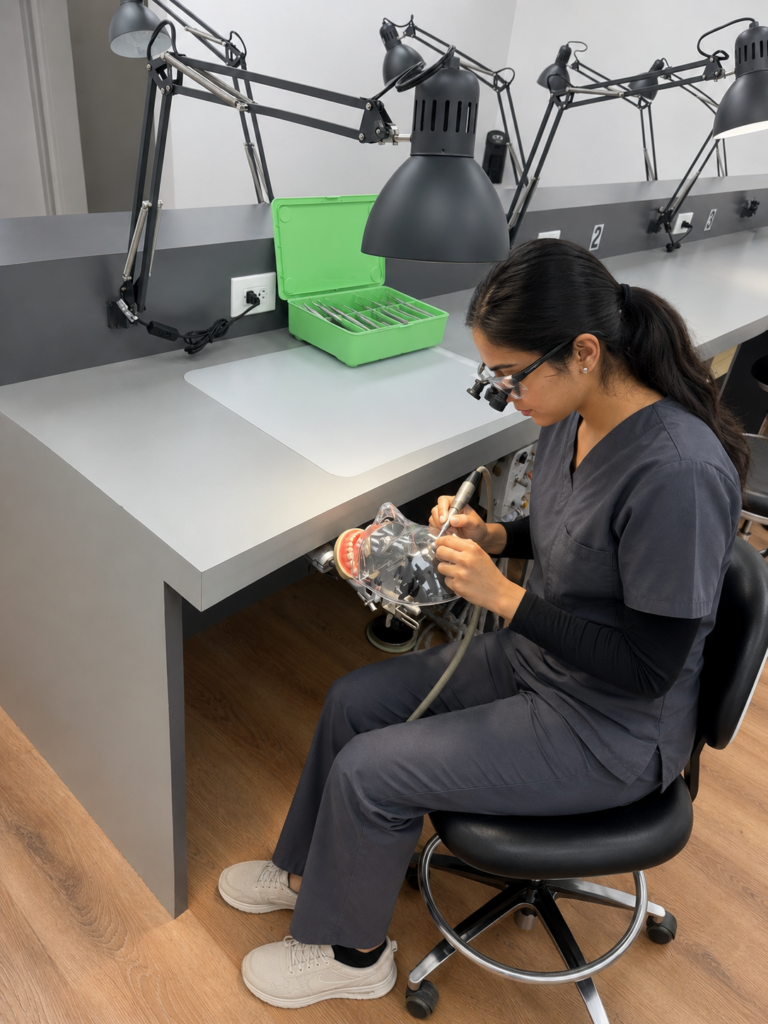
If you’ve made it past understanding what a bench exam is and accepting that it’s genuinely hard, the next question is the practical one: what exactly should you be practicing?
Universities don’t publish an identical script, and every program has its own quirks. But across most Advanced Standing bench exams, the same core categories show up again and again. Here’s what to focus on.
Operative Preparations
This is where most bench exams start. You’ll typically be asked to perform Class II preparations — the kind of interproximal cavity prep every dentist has done thousands of times on real patients. The catch is that a typodont doesn’t behave like a real tooth, and evaluators aren’t just checking whether the prep is “clinically fine.” They’re checking outline form, depth, wall angles, and whether you followed ideal principles under time pressure — not shortcuts you might use in daily practice.
Fixed Prosthodontic Preparations
Full-coverage crown preparations are almost universal on bench exams. This means clean margins, correct taper, adequate reduction, and a finish line an evaluator can actually read. Many candidates who are excellent clinically still lose points here — not because the crown prep is wrong for a patient, but because it doesn’t meet the more exacting, textbook-standard criteria bench exams are built around.
Removable Prosthodontics
Some programs include exercises related to removable prosthesis design or edentulous configurations. This tends to be less universal than operative and fixed prosthodontic work, but it’s worth confirming with your target school’s specific requirements, since expectations vary more here than anywhere else.
Timed Execution
Regardless of which procedures show up, nearly every bench exam runs on a strict clock. This is often the real variable that trips candidates up — not the procedure itself, but performing it accurately while watching time run out. It’s a different kind of pressure than a normal clinical day, and it doesn’t go away just because you understand the steps.
What Evaluators Are Actually Looking For
Across all these procedures, evaluators tend to focus on the same things: precision, consistency, and whether your work reflects sound, repeatable technique — not a lucky single attempt. That’s the real skill being tested. Not “can you do a crown prep once,” but “can you do it correctly, on demand, under pressure, the same way every time.”
Why Watching Isn’t the Same as Practicing
It’s tempting to prepare by watching more videos or reviewing more diagrams. But bench exams test hands, not knowledge. The only way to build the kind of consistency evaluators are looking for is repetition — picking up the handpiece, working against the clock, getting honest feedback on the result, and doing it again.
If you want structured guidance on building that repetition, our CAAPID application guide covers how bench preparation fits into the broader admissions timeline, and when you’re ready to take the next step, you can start your application.
Related Astra Resources
For a deeper breakdown of what each procedure category involves, Astra’s Bench Skills Guide and Bench Examination Guide are good next steps. And if you’re still weighing whether the exam is as hard as it sounds, we cover that in Is the Advanced Standing Dental Bench Test Really That Hard?