


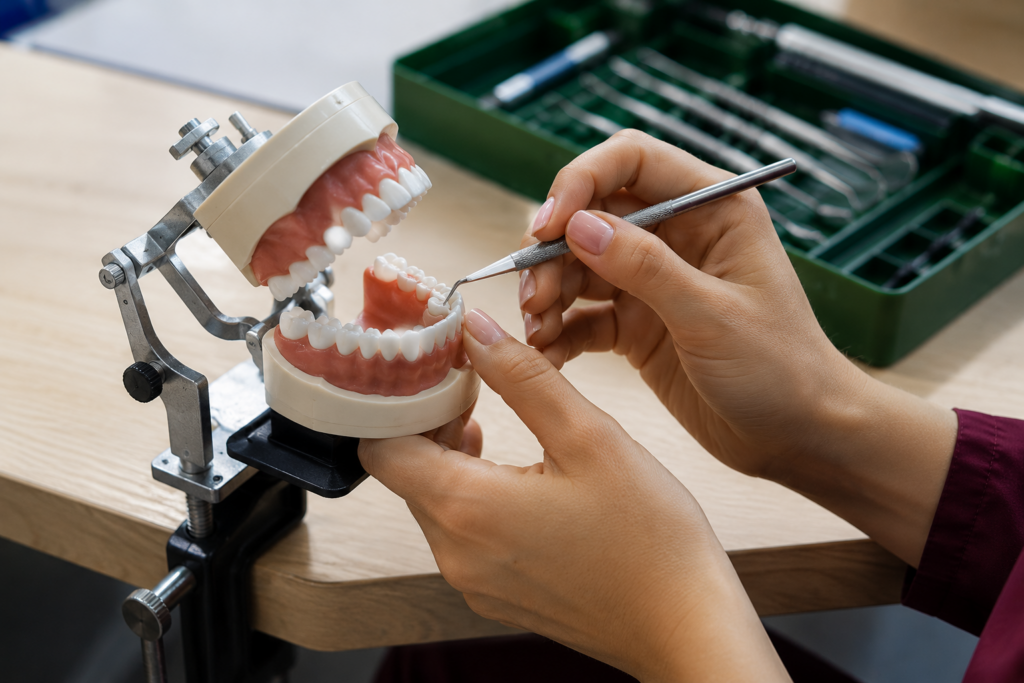
For many internationally trained dentists applying to U.S. Advanced Standing dental programs, the bench test can be one of the most intimidating parts of the admissions process. You may have years of clinical experience, yet suddenly you are being asked to complete precise preparations on a typodont under strict time constraints while being evaluated.
So, is the Advanced Standing dental bench test really that hard?
The short answer: it can be — but often not for the reasons applicants expect.
Why Does the Bench Test Feel So Difficult?
The difficulty is not simply about knowing how to prepare a tooth. Most internationally trained dentists have already performed restorative procedures clinically. The challenge is adapting those skills to a highly controlled simulation environment where small details matter.
During a bench test, you may be working against the clock while trying to maintain precise reduction, taper, margins, anatomy, and finish. At the same time, you are working on a typodont rather than a patient — sometimes with unfamiliar instruments, materials, or evaluation criteria.
That combination can make even an experienced dentist feel like a student again.
The good news is that these are trainable skills.
What Actually Makes a Strong Bench Test Preparation?
A strong bench test preparation is not necessarily the one that looks the most impressive at first glance. Evaluators are looking for controlled, reproducible work that follows the expected preparation principles.
This means developing consistency in areas such as reduction, taper, margin design, smoothness, anatomy, and preservation of tooth structure. Just as importantly, you need to be able to reproduce that quality within the allotted time.
One excellent preparation after several attempts is not the goal. The goal is being able to produce a predictable result repeatedly.
Consistency under time pressure is what turns technical knowledge into bench-test readiness.
The Biggest Mistake: Practicing Without Objective Feedback
Simply doing more preparations does not automatically make you better. One of the most common problems is repeating the same preparation technique without understanding exactly where the errors are.
A preparation may look acceptable from one angle while having excessive taper, inadequate reduction, an uneven margin, or unnecessary removal of tooth structure. If those issues are not identified early, repetition can actually reinforce the wrong technique.
Effective practice should follow a cycle: prepare, evaluate, identify specific deficiencies, correct them, and repeat.
Over time, the goal is to depend less on correction because you begin recognizing problems while you are working — not after the preparation is finished.
Practice builds repetition. Feedback builds improvement.
Does Speed Matter in a Bench Test?
Yes — but speed should come after control.
Trying to work faster before developing a repeatable technique often leads to over-reduction, damaged adjacent teeth, irregular margins, or unnecessary corrections. Those corrections can consume more time than working methodically from the beginning.
A better approach is to first develop a consistent sequence for each preparation. Once that sequence becomes familiar, gradually introduce time limits and practice under conditions that resemble an actual bench examination.
The goal is not simply to finish quickly. It is to finish predictably, accurately, and within the required time.
Accuracy first. Consistency second. Speed follows.
So, Is the Advanced Standing Dental Bench Test Really That Hard?
Yes, the bench test can be challenging. But the difficulty is not necessarily because the procedures themselves are unusually complicated.
The challenge comes from having to perform precise work consistently, within a limited amount of time, while knowing that your preparation is being evaluated. For internationally trained dentists who may not have worked on a typodont recently, that environment can initially feel unfamiliar.
With structured practice, objective feedback, and repeated exposure to timed simulation, the process becomes much more manageable.
The goal is not perfection. The goal is controlled, consistent improvement.
Final Thoughts
The Advanced Standing dental bench test is challenging, but it becomes much more manageable when preparation is approached systematically.
Rather than focusing only on completing more preparations, focus on developing a repeatable technique, evaluating your work objectively, correcting specific deficiencies, and gradually introducing time pressure.
Good bench test preparation is not about practicing until you get it right once. It is about developing the consistency to do it right repeatedly.
If you’d like a clearer picture of how the bench test fits into the overall admissions process, our CAAPID application guide walks through each step. When you’re ready to move forward, you can start your application at any time.
Related Astra Resources
Astra’s Bench Examination Guide and Bench Skills Guide break down exactly what evaluators look for, and our guide on what to practice for the Advanced Standing bench test turns that into a step-by-step plan.
Ready to turn this into hands-on practice? Explore Astra’s two-week Advanced Standing Bench Preparation Track in Pasadena.